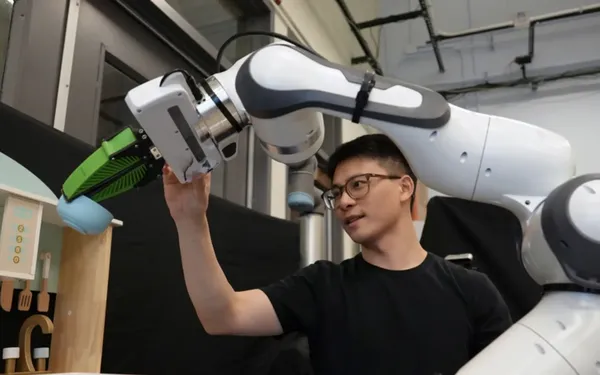
Building capable robots is no longer just a hardware or controls problem. Increasingly, progress depends on whether teams can collect the right data, at the right scale, and in the right format for learning-based systems. For robotics teams working on manipulation, navigation, humanoids, or embodied AI, the choice of data collection method can determine how well a model learns, transfers, and performs in the real world.
One of the central challenges in embodied AI is the data moat, the gap between the data required to train general-purpose models and what is actually available.
Closing this gap has led to a range of data collection strategies, each shaped by different assumptions and goals. These approaches produce different kinds of data with distinct strengths and limitations. This article provides an overview of these methods, the data they yield, and their practical use cases.
What's the best collection method?
The best data collection method depends on what the model needs to learn. Some methods are better for scale and pretraining, while others are better for precise robot execution or full-body control. The sections below compare four important approaches and explain when each one is most useful.

Why Robotics Data Collection Methods Matter
The current robotics landscape has changed drastically as the field shifts from traditionally programmed and model-based systems toward learning-based approaches. Rather than explicitly defining every behavior through engineered pipelines, modern robotic systems increasingly learn from data, demonstrations, and interaction with the world.
Because of this transition, data has become one of the central drivers of progress in robotics. The way data is collected now directly shapes what robotic systems are capable of learning, from manipulation and navigation to planning and full-body coordination. Different collection methods provide different trade-offs in scalability, embodiment alignment, precision, and diversity.
As robotic systems become more general-purpose, the ability to gather large amounts of high-quality data is increasingly becoming a bottleneck. This has led to growing investment in scalable data collection pipelines, multimodal datasets, and interfaces designed to make demonstrations easier to capture [1], [2]. Understanding these collection methods is therefore important not only for understanding how modern robots are trained, but also for understanding where the field itself is heading.
Egocentric Human Data
Egocentric human data is captured from a person’s point of view, typically using a camera mounted on the head or forehead while they perform everyday activities. This setup records interactions as they naturally unfold, preserving both the visual context and the sequence of actions. A key advantage of this type of data is that it reflects human dexterity and an intuitive understanding of how actions lead to outcomes in the physical world.
In practice, egocentric datasets go beyond raw video. They often include additional signals to ground the observations, such as a consistent frame of reference, hand and object tracking, and sometimes depth or pose information. These elements make it easier to relate what is seen to what is being done. Depending on the application, the data may also include natural language annotations that describe actions, intentions, or task structure, which can help bridge perception and decision-making.
When Is Egocentric Human Data Used?
Egocentric human data has a wide range of applications, but it is most commonly used for model pretraining. Because it is relatively easy to collect and naturally captures how humans understand action–reaction dynamics, it provides a strong foundation for learning physical interactions. At scale, this kind of data helps models build an intuitive prior over how the world responds to actions, which can later be refined with more task-specific or robot-collected data.
That strength also points to a key limitation: the gap between human actions and robotic embodiments. Data captured from human hands does not always translate cleanly to a robot’s end effector, especially when the kinematics or capabilities differ significantly. Differences in degrees of freedom, precision, and contact dynamics mean that a behavior that is trivial for a human may be infeasible or require a different strategy for a robot. While there has been work aimed at bridging this gap, such as EgoBridge [3], these approaches remain largely exploratory and have yet to see broad practical adoption.
In practice, this means egocentric human data is often most effective when used as a foundation rather than a complete solution. It can shape representations, inform world models, or guide policy learning, but it is typically complemented with robot-specific data or adaptation methods to ensure reliable execution on the target platform.
Example: Dream Dojo and Egocentric Data
Nvidia’s Dream Dojo [1] is one of the clearest success cases for the role of egocentric human data in robotics. It is a generalist world model trained on 44,000 hours of egocentric human data, giving it broad exposure to real-world interactions as they naturally occur from a human perspective. This scale and diversity allow the model to learn not just isolated actions, but the structure of how actions unfold over time in different environments.

In the paper, the model reports a Pearson correlation of 0.995 between its predicted outcomes and real-world task success rates. This is a strong indication that the learned world model captures meaningful aspects of physical dynamics and can reliably anticipate the results of actions. Rather than directly controlling a robot, the model serves as a predictive layer that can evaluate or guide decision-making, which is particularly useful for planning.
The dataset itself emphasizes manipulation tasks across a wide variety of environments, exposing the model to different objects, contexts, and interaction patterns. This diversity is key to its generalization ability, especially in scenarios that are difficult to simulate or script. More broadly, Dream Dojo highlights how egocentric human data can be used to learn rich representations of the physical world at scale, strengthening the case for its role as a foundation in embodied AI systems.
Teleoperation Data
Teleoperation data is collected by remotely controlling a robot while it performs tasks. Unlike egocentric human data, it directly reflects the robot’s embodiment, capturing how actions are executed within its kinematic and control constraints. As a result, it tends to be rich and well-structured, typically including precise end effector poses, joint states, and synchronized visual observations.
This data can be gathered through a range of interfaces, from VR-based teleoperation to more traditional setups like leader follower arms. Each modality offers a different balance between ease of use and control fidelity, but all share the advantage of producing demonstrations that are immediately actionable for the robot. Because of this alignment, teleoperation data is often used for imitation learning or policy training, where the goal is to replicate demonstrated behaviors with high accuracy.
When Is Teleoperation Data Used?
Teleoperation data, in contrast to egocentric human data, typically sits at the end of the training pipeline. It is most often used during fine-tuning, where the goal is to adapt a model to a specific robot and task. While it is more difficult and expensive to collect, it provides the highest level of alignment with the robot’s embodiment.
Because the data is generated directly through the robot’s sensors and control interface, it reflects the exact kinematics, constraints, and action space the model must operate in. This makes it especially effective for refining policies and improving execution reliability. In practice, teleoperation data builds on earlier stages like pre training, grounding the model in the realities of the physical system and closing the gap between general understanding and precise control.
Example: RT-1 and Teleoperation Data
A well-known success case is Google RT-1 from Google Research.RT-1 was trained on a large dataset of real-world robot demonstrations collected through teleoperation. Because the data came directly from the robot’s own sensors and control interface, the model learned behaviors that were immediately executable, from picking up objects to opening drawers.
What made this notable is that the system was deployed on real robots and showed strong generalization across tasks and environments, while maintaining high success rates. The teleoperation data was key here, it grounded the model in the robot’s actual embodiment, allowing it to translate learned policies into reliable physical actions.
UMI Data
UMI, or Universal Manipulation Interface [2], refers to a class of data collection setups designed to standardize how manipulation data is recorded. This data is typically collected using handheld devices, often referred to as grippers, that mimic the function of a robot’s end effector while being operated by a human.
These devices can vary in their specific design and sensing capabilities, but they usually share a common structure: a simplified gripper with consistent geometry and control signals. This standardization makes it easier to map human demonstrations to robotic actions, reducing the embodiment gap present in purely egocentric data. In addition to position and orientation, UMI setups often capture grip state, force signals, and sometimes tactile feedback, providing a richer description of the interaction.
Because of this alignment, UMI data sits somewhere between egocentric human data and teleoperation data. It retains the ease and intuitiveness of human demonstrations while producing signals that are closer to what a robot can directly execute. As a result, it is increasingly used in scenarios where transferring manipulation skills to robots needs to be both scalable and precise.
When Is UMI Data Used?
As mentioned before, UMI data falls somewhere between teleoperation and egocentric human data, and its role in the training pipeline reflects that middle ground. It can be used during the pretraining phase of a model, where the goal is to expose the system to a broad range of manipulation behaviors and interaction dynamics. At the same time, because the demonstrations are already closer to a robot-compatible action space, it can also serve as an intermediate adaptation stage before robot-specific fine-tuning.
This makes UMI data particularly valuable for bridging the gap between general physical understanding and embodiment-specific control. Compared to egocentric data, it offers stronger alignment with robotic manipulation, while remaining easier and more scalable to collect than full teleoperation data. In practice, this allows models to learn transferable manipulation priors that can later be refined with smaller amounts of teleoperated or on-robot data.
Example: Gen-1 and UMI Data
Generalist AI’s Gen-1 [5] is one of the strongest examples of the potential of UMI data in robotics. To train the system, the team collected several thousand hours of UMI-based manipulation data, allowing the model to observe a large variety of real-world interactions through a standardized interface.
One of the main advantages of this approach is scalability. Because UMI setups are easier to operate than full teleoperation rigs while still producing robot-aligned demonstrations, they make large-scale data collection more practical. This enabled Gen-1 to learn manipulation behaviors across many tasks and environments without relying exclusively on expensive robot teleoperation.
The resulting system demonstrated strong manipulation capabilities, particularly in contact-rich tasks and object handling scenarios that require precise coordination. More broadly, Gen-1 helped validate the idea that UMI data can act as an effective bridge between human demonstrations and robotic execution, combining some of the scalability of egocentric data with the embodiment alignment of teleoperation.
Mocap Data
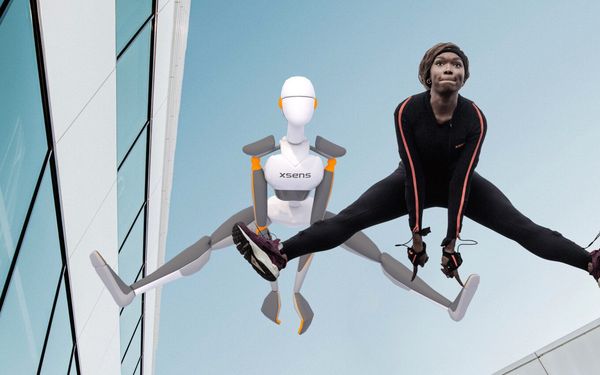
Motion capture, or mocap, data is another form of human-collected data used in robotics and embodied AI. Unlike egocentric datasets, which focus primarily on the visual perspective of the human, mocap data is designed to capture full-body movement. This includes body pose, joint trajectories, limb coordination, and sometimes even fine-grained hand or finger motion.
Mocap systems can be built using wearable sensors, marker-based tracking systems, or vision-based pose estimation setups. The result is a detailed representation of how humans move and coordinate actions over time. Because of this, mocap data is especially useful for studying locomotion, balance, whole-body control, and dynamic manipulation tasks that require coordination beyond the hands alone.
When Is Mocap Data Used?
Mocap data is commonly used to capture full-body control and movement, making it especially valuable for humanoid robotic systems. Unlike datasets focused only on hand actions or object interactions, mocap provides a detailed view of how the entire body moves and coordinates during a task.
Because of this, it is particularly useful for applications that require a strong understanding of balance, posture, and locomotion. Humanoid robots often need to coordinate multiple joints while maintaining stability, and mocap data helps model these complex movement patterns. Tasks such as walking, lifting, crouching, or reaching all depend on whole-body coordination, not just end effector control.
In practice, mocap data is frequently used for imitation learning and motion planning, where the goal is to reproduce natural and physically consistent movement. By learning from human motion, robots can develop behaviors that are more stable, efficient, and adaptable in real-world environments.
Example: Atlas and Mocap Data
One of the clearest success cases for mocap data is Atlas from Boston Dynamics [6] . Atlas is known for highly dynamic full-body behaviors such as running, jumping, lifting, and performing coordinated manipulation tasks while maintaining balance. These types of motions are extremely difficult to hand-engineer because they require precise coordination across the entire body.
Mocap data has been valuable in this context because it provides realistic examples of how humans distribute weight, stabilize themselves, and coordinate movement during complex actions. By learning from human motion patterns, humanoid systems can develop behaviors that are more stable, efficient, and physically natural. Atlas helped demonstrate that full-body motion data is not only useful for animation or simulation, but also for enabling real-world humanoid robotics.
Closing Thoughts
This is only an introduction to the wide range of data collection methods and data sources used in robotics. It is by no means exhaustive, and many important details and trade-offs within each approach have only been touched on briefly. The robotics data ecosystem is still evolving rapidly, with new collection methods, interfaces, and scaling strategies continuing to emerge.
Still, understanding these categories is important because data ultimately shapes what robotic systems can learn, generalize, and accomplish in the real world. Different forms of data provide different strengths, from the scalability of egocentric recordings to the embodiment alignment of teleoperation and the full-body coordination captured through mocap systems.
If you are interested in learning more about these data collection methods, exploring their trade-offs in greater depth, or require support collecting data for robotics applications, feel free to connect with us: Free Consultation with Nurvai
Connect with us on socials
References
[1] N. G. Lab, “DreamDojo: A generalist robot world model from large-scale human videos,” arXiv preprint arXiv:2602.06949, 2026, Available: https://arxiv.org/abs/2602.06949
[2] C. Chi et al., “Universal manipulation interface: In-The-Wild robot teaching without In-The-Wild robots,” in Proceedings of robotics: Science and systems (RSS), 2024. Available: https://arxiv.org/abs/2402.10329
[3] R. Punamiya et al., “EgoBridge: Domain adaptation for generalizable imitation from egocentric human data,” in arXiv preprint arXiv:2509.19626, 2025. Available: https://arxiv.org/abs/2509.19626
[4] A. Brohan et al., “RT-1: Robotics transformer for real-world control at scale,” arXiv preprint arXiv:2212.06817, 2022, Available: https://arxiv.org/abs/2212.06817
[5] Generalist AI, “GEN-1: Scaling embodied foundation models to mastery.” Blog post, 2026. Available: https://generalistai.com/blog/apr-02-2026-GEN-1
[6] G. Nelson and B. D. A. Institute, “Learning dynamic whole-body manipulation for humanoid robots,” in Proceedings of the IEEE international conference on robotics and automation (ICRA), 2024. Available: https://bostondynamics.com/atlas